What Is the Hidden Wiki?
The Hidden Wiki is an informational directory that lists links to various websites commonly associated with hidden or non-indexed parts of the internet. It is often compared to a wiki-style index, where content is organised into categories to help users understand different types of hidden services.
Unlike regular websites on the surface web, the Hidden Wiki is known for pointing to sites that are not easily accessible through standard search engines. Its primary purpose is to act as a reference point, offering general information rather than hosting content directly.
It is important to note that the Hidden Wiki itself does not control or verify the content of external links. As a result, the quality, accuracy, and safety of listed resources can vary significantly. For this reason, the Hidden Wiki is best viewed as an educational or informational resource rather than a trusted authority.
History and Background of the Hidden Wiki
The Hidden Wiki emerged as one of the early directory-style resources associated with hidden and non-indexed websites. Its concept was inspired by traditional wiki platforms, where information is organised collaboratively and presented in a simple, categorised format.
Over time, the Hidden Wiki became known as a reference point for users seeking general awareness about hidden services. As interest in online privacy and anonymous networks grew, different versions of the Hidden Wiki began to appear, each maintained by different individuals or groups. This led to variations in content quality, structure, and reliability.
The Hidden Wiki has evolved significantly since its early days. Many links listed in older versions became inactive, while newer versions attempted to update or reorganize content. Because there is no single official version, the Hidden Wiki today is best understood as a concept rather than a single, authoritative website.
Throughout its history, the Hidden Wiki has remained a topic of debate and curiosity. While some view it as an informational index, others associate it with misinformation due to the lack of centralised moderation. This background highlights why users are encouraged to approach the Hidden Wiki with caution and critical understanding.
How Does the Hidden Wiki Work?
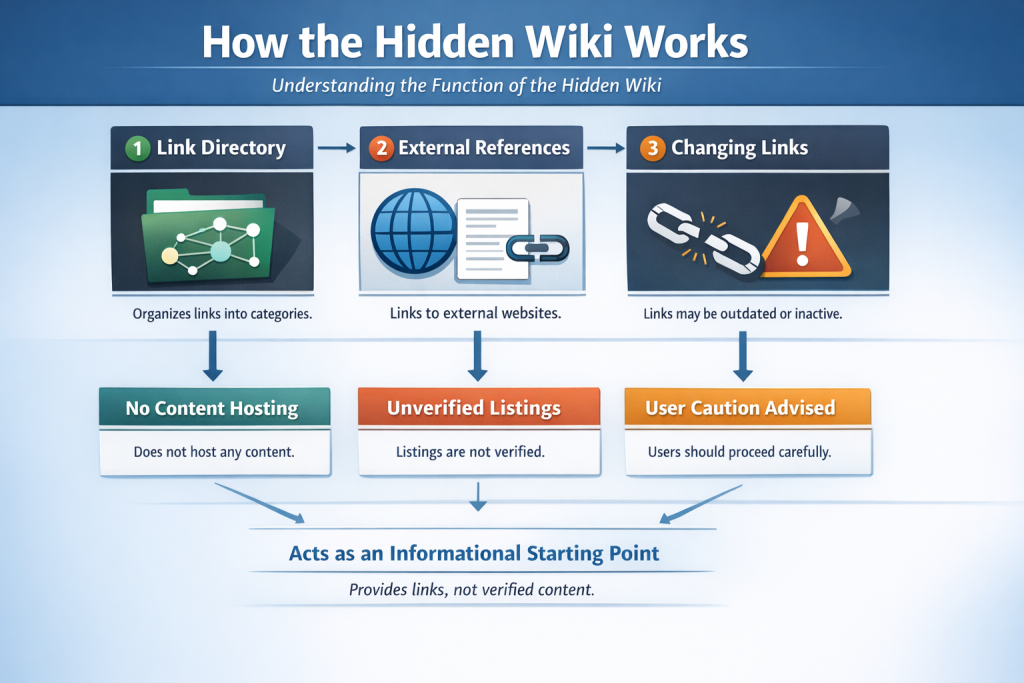
The Hidden Wiki functions as a directory-style index that organizes links into different categories. Instead of hosting content itself, it provides references to external websites that may not be easily discoverable through standard search engines.
Content on the Hidden Wiki is usually arranged in a list or wiki format, making it easier for users to browse topics by category. These categories can vary depending on the version of the Hidden Wiki, as there is no single authority managing all versions.
Because the Hidden Wiki does not control the external websites it links to, the availability and accuracy of listed links can change frequently. Some links may become inactive over time, while others may lead to content that differs from the original description.Overall, the Hidden Wiki works as an informational starting point, not a verified or curated platform. Users are expected to approach the information with caution and make independent judgments when reviewing any listed resources.
Purpose of the Hidden Wiki
The primary purpose of the Hidden Wiki is to act as an informational directory that helps users understand the existence of websites that are not commonly indexed by traditional search engines. It serves as a reference point rather than a content-hosting platform.
The Hidden Wiki is often used to organize links into categories, making it easier to explore topics related to hidden services in a structured way. Its goal is to provide general awareness, not recommendations or endorsements of any specific website.
Another key purpose of the Hidden Wiki is educational. It helps users learn about how hidden networks operate, the variety of content that exists online, and the importance of caution and responsibility while browsing unfamiliar digital spaces.Overall, the Hidden Wiki is intended to function as a starting point for information, encouraging users to approach online content with critical thinking rather than as a guide for action.
Types of Content Found on the Hidden Wiki
The Hidden Wiki typically organizes links into various categories to help users understand the range of content that exists across hidden services. These categories can differ depending on the version of the Hidden Wiki, but they generally focus on broad topics rather than detailed descriptions.
Common types of content listed may include informational resources, discussion platforms, privacy-related tools, and community-based websites. Some listings are intended for educational or research purposes, while others may focus on general communication or technology-related topics.
It is important to note that content quality can vary significantly. Some links may lead to outdated or inactive websites, while others may point to content that is incomplete or unreliable. Because the Hidden Wiki does not verify external sites, users are encouraged to approach all listings with caution.
Overall, the variety of content found on the Hidden Wiki reflects the diversity of online spaces, highlighting the need for awareness, responsibility, and critical evaluation when exploring unfamiliar digital environments.
Different Versions of the Hidden Wiki
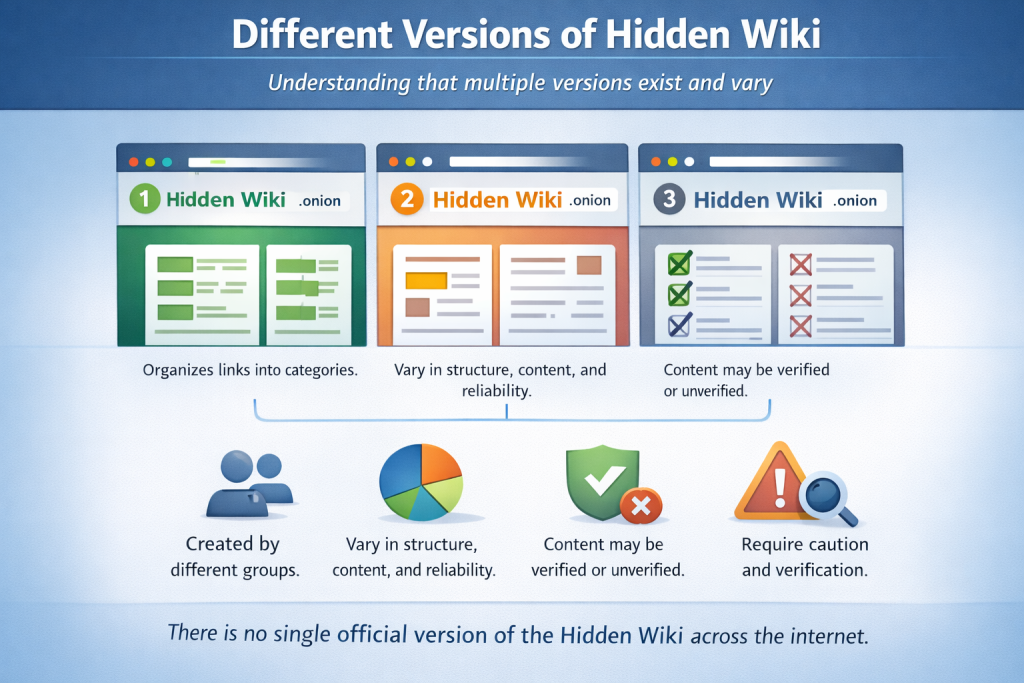
There is no single official version of the Hidden Wiki. Over time, multiple versions have appeared, each created and maintained by different individuals or groups. These versions may vary in structure, content categories, and overall reliability.
Some versions focus more on informational and educational listings, while others may contain outdated or unverified links. Because there is no centralized authority, updates and moderation standards differ widely across versions.
As a result, users may encounter different layouts, link collections, and levels of accuracy depending on which version they access. This lack of uniformity is one of the reasons the Hidden Wiki should be viewed as a general reference concept rather than a trusted or authoritative source.
Understanding that multiple versions exist helps explain why experiences with the Hidden Wiki can differ and why caution and independent verification are always advised.
Why the Hidden Wiki Is Often Misunderstood?
The Hidden Wiki is often misunderstood because it is commonly associated with the darker or more controversial parts of the internet. This association can lead people to assume that all content linked through the Hidden Wiki is unsafe or illegal, which is not always accurate.
Another reason for misunderstanding is the lack of a single official version. Because multiple versions exist, experiences can vary widely, causing confusion about what the Hidden Wiki actually represents. Outdated or unmoderated links can further contribute to misinformation.
Media portrayals and online discussions sometimes oversimplify the concept, focusing on extreme examples rather than its broader informational role. This can create a one-sided perception that does not reflect how the Hidden Wiki is used in educational or research contexts.
Overall, misunderstandings arise from mixed content quality, inconsistent moderation, and limited public awareness. Viewing the Hidden Wiki as an informational directory—rather than a definitive source—helps provide a more balanced and accurate understanding.
Is the Hidden Wiki Legal or Illegal?
The Hidden Wiki itself is not illegal. It functions as an informational directory that lists links to external websites. Simply accessing or reading information about the Hidden Wiki does not violate the law in most regions.
However, legality becomes complex because the Hidden Wiki may link to external sites that host illegal or restricted content. These third-party websites operate independently, and the Hidden Wiki does not control or manage what they publish.
Laws regarding online content and access vary by country. What may be legal in one jurisdiction could be illegal in another. For this reason, users are responsible for understanding and complying with their local laws when browsing any online resources.In summary, the Hidden Wiki should be viewed as a neutral informational reference, but users must exercise caution and personal responsibility when interacting with any external links it may list.
Risks Associated With the Hidden Wiki
One of the main risks associated with the Hidden Wiki is the lack of verification for external links. Because listings are not consistently moderated, some links may be outdated, misleading, or point to content that is not suitable for all users.
Another risk involves exposure to unreliable or inaccurate information. Since there is no central authority ensuring accuracy, users may encounter content that is incomplete, false, or misrepresented. This makes critical evaluation essential when reviewing any listed resources.
Privacy and security concerns are also important considerations. Visiting unfamiliar websites can increase the risk of encountering harmful content, malicious software, or privacy-related issues if proper precautions are not taken.
Overall, the risks associated with the Hidden Wiki stem from its open and unverified nature. Approaching it as an informational reference—while remaining cautious and informed—helps reduce potential issues and misunderstandings.
Safety and Privacy Concerns
Safety and privacy are key concerns when discussing the Hidden Wiki due to its open and unregulated structure. Links listed on the platform may redirect users to third-party websites that operate outside standard web safety practices.
From a privacy perspective, users should understand that anonymity does not automatically guarantee protection. Poor security habits, unsafe browsing behavior, or interaction with untrusted sites can increase privacy risks.
Another concern is data exposure. Some external sites may attempt to track activity, collect information, or display misleading content. This highlights the importance of being cautious and avoiding unnecessary interactions.
Overall, the Hidden Wiki should be approached as an informational directory rather than a trusted source. Maintaining awareness, avoiding unknown links, and prioritizing personal privacy helps reduce potential safety concerns.
Reliability of Hidden Wiki Links
The reliability of Hidden Wiki links can vary widely. Since the Hidden Wiki does not consistently verify or monitor external websites, some links may become outdated, inactive, or lead to content that no longer matches their original descriptions.
Because multiple versions of the Hidden Wiki exist, link accuracy depends heavily on who maintains a specific version and how often it is updated. In many cases, links are added or removed without formal review.
Another factor affecting reliability is the changing nature of hidden services. Websites may disappear, relocate, or change their purpose over time, making long-term accuracy difficult to maintain.
For these reasons, the Hidden Wiki should not be treated as a fully reliable source. It is best used as a general reference, with users independently verifying information before relying on or interacting with any external links.
How to access the Hidden Wiki links?
1. Download the Tor Browser
2. Connect to Tor and type hiddenwiki.cc in the URL bar
3. Bookmark this website! CTRL+D and save the bookmark
4. Now you’re ready to browse the Deep Web!
Link Index
- The Ultimate Hidden Wiki – Onion Mirror of The Ultimate Hidden Wiki (verified)
- The Original Uncensored Hidden Wiki – The Original (2013) Uncensored Hidden Wiki (verified)
Search Engines
| Top Web Sites + Verified The easiest and safest way to find the right website.(verified) | GoDark |
| Tor Links is a moderated replacement for The Hidden Wiki. (verified) | TorLinks |
| A good link collection, calls itself the Hidden Wiki mirror. (verified) | Onion List |
| The list of scam site, where you can report about other scam sites. Also we have verified links. (verified) | TOR SCAM LIST |
| A clearnet search engine for Tor hidden services. (verified) | Ahmia.fi |
| A hidden service that searches the clearnet. (verified) | DuckDuckGo |
Financial Services
| Buy Pre-Shredded USD & EURO Currency for a fraction of the value. (verified) | Buy real money |
| Best Financial Service Since 2014 Prepaid Visa / Mastercards Western Union And Paypal 24/7 Support. (verified) | Imperial Market |
| Prepaid VISA / Amex / MasterCards – Western Union and PayPal Moneytransfer within 30 minuntes. (verified) | Cash Cards |
| Discount service of Prepaid Cards, Money Transfers and Gift Cards. (verified) | Light Money |
| Prepaid cards, credit cards, western union and paypal seller. (verified) | Millionaire Exclusive Club |
| Cloned/Prepaid Credit Cards and Money Transfers via PayPal or Western Union Service Since 2015. (verified) | Bankor |
| Oldest cc vendor, Top quality Us & Eu credit cards. (verified) | Premium Cards |
| PrePaid cards, Paypal Transfers and Accounts, Bank Transfers, Western Union Transfers, MoneyGram Transfers, Real Money, Gift Cards Seller. (verified) | Cash Cow |
| PayPal, Western Union and MoneyGram Transfers. (verified) | Team Transfers |
| Prepaid cards, PayPal Accounts, CC Fullz, Western Union Transfers, Moneygram Transfers. (verified) | Fast Money |
| Fast and secure money transfers. Express shipping is free. (verified) | Goldman Financial Services |
| Best Shop for Gift Cards, Payment Cards, Money Transfer and more. (verified) | Digital Goods |
Commercial Services:
- Dark Escrow – Provides online communication tools for individuals and groups engaged in liberatory social change. (verified)
Email & Communication
| Provides online communication tools for individuals and groups engaged in liberatory social change. (verified) | RiseUp |
| A reliable email provider. (verified) | Cock.li |
| A platform for secure messaging and file sharing. (verified) | Keybase |
| A Tor-based, PGP encrypted chat service with multiple anonymous aliases per account. (verified) | Chator |
| A free anonymous email service designed to protect your privacy. (verified) | Mail2Tor |
| A hidden mailbox service only accessible via Tor, with no connection to the public internet. (verified) | TorBox [DOWN] |
| Swiss-based email service which encrypts emails locally on your browser. Offers free and paid accounts. (verified) | Protonmail |
| An anonymous email service. (verified) | Morke |
| A free, disposable email provider. (verified) | AltAddress |
| Danwin’s mail service. (verified) | danwin1210.de |
Adult
| The famous official YL site. (verified) | Young Lovers |
| Official Secret Stars agency website, new 2024 content. (verified) | Secret Stars |
| MyTeens v2.1 (verified) | MyTeens |
| Official onion mirror of website that everybody knows. (verified) | PonrHub [DOWN] |
Crypto
| Buy and sell Monero via its .onion domain. (verified) | LocalMonero.co |
| A Bitcoin blockchain explorer by Blockstream. (verified) | Blockstream BTC Explorer |
| A comprehensive Bitcoin blockchain explorer. (verified) | BlockChair BTC Explorer |
| Buy or Sell Bitcoin Anonymously. (verified) | AgoraDesk |
| Automatic cryptocurrency swaps. (verified) | eXch |
| Swap Monero and Bitcoin. (verified) | swp.cx |
Anonymity & Privacy Tools
| The VPN service provider for the truly paranoid. (verified) | Stormways |
| The air to breathe the real Internet. (verified) | AirVPN |
| Virtual anonymous OS. (verified) | Whonix OS |
| Anonymous OS used by Snowden. (verified) | Qubes OS |
| Tool to check your anonymity and generate fake ID. (verified) | Elf Qrin’s Lab |
Hosting
| Code hosting for friendly people. (verified) | 0xacab |
| Darknet hosting operating on a secure Gentoo Hardened platform. (verified) | Kaizushi’s Little Onion Server |
| Offers API-driven VPS hosting payable via Bitcoin, with both clearnet and hidden Tor hosting options. (verified) | SporeStack |
| An anonymous free hosting service with PHP/MySQL support. (verified) | Freedom Hosting Reloaded |
| Onion website of Ablative Hosting. (verified) | Ablative Hosting |
Image/File Share
| Secure file-sharing with OnionShare. (verified) | OnionShare |
| Provides secure messaging and file-sharing services. (verified) | KeyBase |
Whistleblowing
| Whistleblowing platform. (verified) | The Guardian |
| The open-source whistleblower submission system managed by the Freedom of the Press Foundation. (verified) | SecureDrop |
| Whistleblowing submission platform. (verified) | AfriLeaks |
Other Tools
OSINT
| Discover relations between millions of organizations and individuals. (verified) | RelateList |
| Search through a Facebook data dump. (verified) | Fuck Facebook |
Pastebin
| (Verified) | Tor Paste |
| ZeroBin is a minimalist, opensource online pastebin where the server has zero knowledge of pasted data. (verified) | ZeroBin |
| Simple pastebin. (verified) | Stronghold Paste |
| A minimalist, but useful .onion pastebin. (verified) | BlackCloud |
| A good pastebin with end-to-end encryption. (verified) | Keybase |
Radio
No Tone – Tune in for some great music. (verified)
Torrent
(please, use VPN to download torrents, unless you need extra anonymity. Downloading torrents through TOR stresses the network a lot and is not necessary in most cases.)
| Onion version of the Pirate Bay torrent site. (verified) | The Pirate Bay |
| Onion version of the popular bittorrent site’s forums. (verified) | The Pirate Bay Forum |
| The torrent galaxy. (verified) | TGx |
Libraries & Archives
| Onion version of the multilingual web archiving service Archive.today. (verified) | Webpage Archive |
| A comic book repository. (verified) | Comic Book Library |
| A library offering books, courses, and art content. (verified) | Just Another Library |
Social
| Official Onion domain of Facebook. Claims not to keep logs, trust at your own risk. (verified) | |
| Anonymous discussion forum. (verified) | Dread |
Forums
| Famous Russian hacking forum. (verified) | xss.is |
| Another famous Russian hacking forum. (verified) | Exploit.in |
| Big German forum. (verified) | Germania |
| Forum for autistic edgelords. (verified) | EndChan |
Official Websites
| The official site. (verified) | National Police of the Netherlands |
| The CIA’s official Onion site. (verified) | The CIA |
| Official site of the NCIDE Task Force. (verified) | NCIDE Task Force |
| U.S. government rewards program for information on international criminal activities. (verified) | Rewards For Justice |
| The official site of the Tor Project. (verified) | Tor Project |
Conferences
News
| The official .onion Secure Drop of The New York Times. (verified) | The New York Times Secure Drop |
| Investigative journalism and news in the public interest. (verified) | ProPublica |
| The official .onion website of BBC News. (verified) | BBC News |
| A popular news site covering Darknet matters. (verified) | Darknet Live |
| The official .onion website of Deutsche Welle. (verified) | Deutsche Welle |
| A simple website listing active leak sites of ransomware groups. (verified) | Ransomware Group Sites |
Blogs, Wikis And Personal Sites
| A community-driven online encyclopedia that aims to document the field of psychonautics. (verified) | PsychonautWiki |
| Uncensored Bible for the Darknet. (verified) | Bible4u |
| A blog exploring outer space topics. (verified) | Outer Space |
| A site dedicated to technology learning. (verified) | Tech Learning Collective |
| A personal blog space. (verified) | Fuwa Fuwa |
| May Vane Day Studios. (verified) | MayVaneDayStudios |
| The Shadow Wiki Blog. (verified) | ShadowWiki |
| A blog for those who feel lost. (verified) | S-Config |
| A German technology blog. (verified) | SystemLI |
| A technology-based wiki covering various computer topics and software. (verified) | Wizardry and Steamworks |
| Free information for everyone. (verified) | TheYosh.nl |
| Security tutorials and blog. (verified) | JamieWeb |
Other Languages
| Brazilian Q&A forum, similar to Yahoo Answers. (verified) | Respostas Ocultas |
| A free and non-moderated forum. (verified) | French Pool |
| A Russian multi-topic forum. (verified) | Verified |
| A Russian news website and more. (verified) | Ros |
| Библиотека (library). (verified) | Флибуста |
Why Hidden Wiki Links Frequently Change?
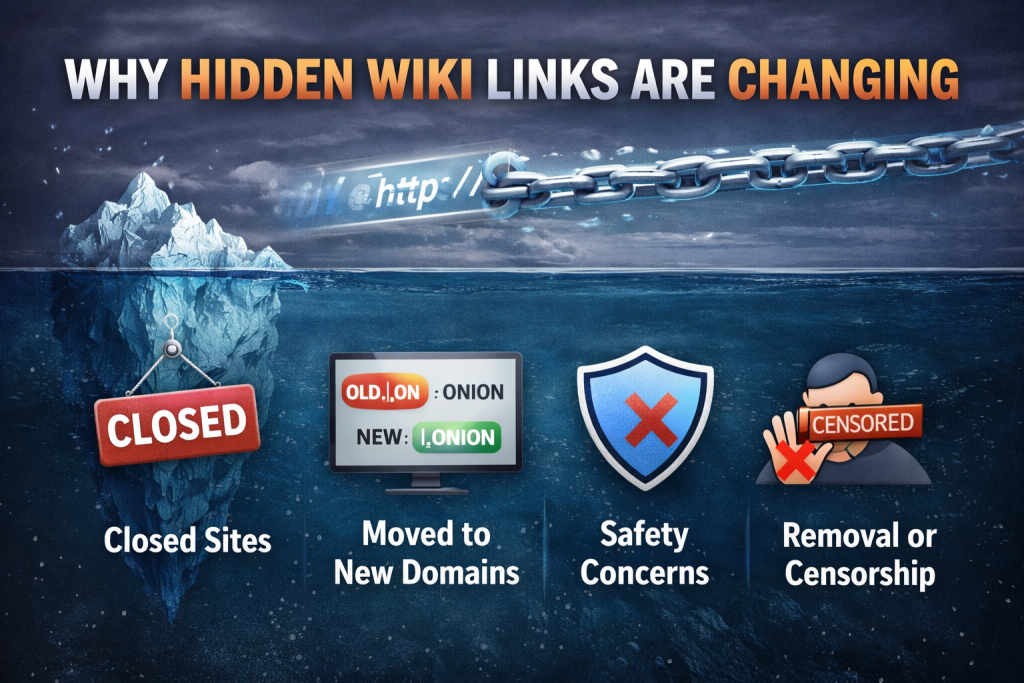
Hidden Wiki links frequently change due to the unstable and temporary nature of many hidden services. Unlike regular websites, these sites may go offline, move to new locations, or shut down without notice.
Another reason for frequent changes is the lack of centralized management. Since there is no single authority controlling all versions of the Hidden Wiki, links may be added, removed, or edited by different maintainers at different times.
Security and privacy concerns also play a role. Some websites intentionally change addresses or stop operating to reduce exposure or avoid unwanted attention, which can lead to broken or outdated links.
As a result, link inconsistency is common. This is why the Hidden Wiki is best viewed as a dynamic reference rather than a stable or permanent directory.
Hidden Wiki vs Surface Web Directories
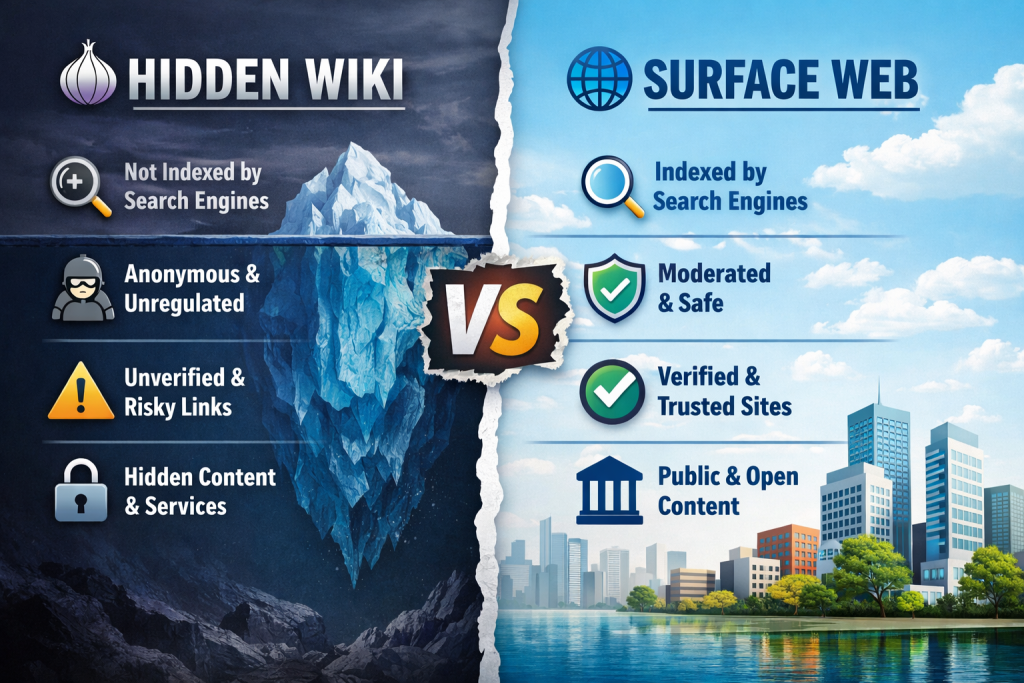
| Feature | Hidden Wiki | Surface Web Directories |
| Accessibility | Only via Tor browser or dark web access | Accessible via standard browsers (Chrome, Firefox, etc.) |
| Content Type | Dark web links, forums, marketplaces, uncensored content | Regular websites, blogs, business listings, e-commerce |
| Anonymity | High – users often remain anonymous | Low – most require registration or trackable info |
| Indexing | Limited and manually maintained | Indexed by search engines like Google, Bing |
| Safety | Risky – potential malware, scams, illegal content | Safer – mostly regulated and monitored |
| Legality | Many links may be illegal | Mostly legal and regulated |
| Navigation | Non-linear, often confusing for new users | Easy, user-friendly, categorized by topics |
| Update Frequency | Links may be outdated or dead | Frequently updated and maintained |
| Purpose | Access hidden/dark web content | Discover websites, businesses, services online |
Deep Web vs Dark Web
The Deep Web and Dark Web are often confused, but they are not the same. The Deep Web refers to parts of the internet that are not indexed by search engines, such as private emails, online banking portals, membership-based websites, and cloud storage. Most people use the Deep Web daily without realizing it.
The Dark Web, on the other hand, is a small portion of the internet that is intentionally hidden and requires special software or configurations to access. Websites on the Dark Web are not indexed by traditional search engines and operate separately from the surface web.
The Hidden Wiki is commonly associated with the Dark Web, not the Deep Web. However, this does not mean all Dark Web content is illegal. The key difference lies in access method and visibility, not intent.
Understanding the distinction between the Deep Web and Dark Web helps reduce confusion and allows users to better understand where the Hidden Wiki fits within the broader internet landscape.
Educational Use of the Hidden Wiki
The Hidden Wiki can be used as an educational reference to help users understand how hidden services and non-indexed websites are structured. From an academic or research perspective, it offers insight into alternative online networks and how information can exist outside traditional search engines.
Students, researchers, and cybersecurity learners may use the Hidden Wiki to study topics such as online anonymity, digital privacy, and the challenges of content moderation on decentralized platforms. When viewed responsibly, it can support broader discussions about internet freedom and information access.
It is important to emphasize that educational use does not involve interacting with or relying on unverified external links. Instead, the value lies in understanding concepts, risks, and the structure of hidden networks.Overall, the Hidden Wiki’s educational relevance comes from awareness and analysis, not direct usage. Approaching it with a critical mindset helps ensure it remains a learning tool rather than a source of misinformation.
Common Myths About the Hidden Wiki
One common myth is that the Hidden Wiki itself is illegal. In reality, it functions as an informational directory, and legality depends on how external links are used rather than the directory itself.
Another misconception is that all content listed on the Hidden Wiki is dangerous or criminal. While some links may point to questionable or unreliable content, not every listing is harmful. The quality and intent of linked sites vary widely.
Many people also believe that the Hidden Wiki guarantees anonymity and privacy. This is incorrect, as no website can fully ensure privacy without responsible user behavior and awareness of online risks.
Finally, some assume the Hidden Wiki is a single, official website. In fact, multiple versions exist, each maintained differently. Understanding these myths helps create a more balanced and accurate view of what the Hidden Wiki actually represents.
Who Usually Uses the Hidden Wiki?
The Hidden Wiki is used by a wide range of individuals for different informational purposes. Researchers and students may explore it to better understand hidden networks, online anonymity, and how non-indexed websites operate.
Some users interested in digital privacy and internet structure view the Hidden Wiki as a reference point for learning about alternative online spaces. Journalists and cybersecurity learners may also study it to gain insight into how decentralized directories function.
It is important to note that usage does not imply intent. People access information for many reasons, including education, curiosity, or research. The Hidden Wiki itself does not define how users interact with external content.
Overall, the audience of the Hidden Wiki is diverse, and its use varies depending on individual goals, awareness, and responsibility.
How Search Engines View the Hidden Wiki?
Search engines generally view the Hidden Wiki as an informational concept rather than a traditional website category. Because most versions are not indexed on the surface web, search engines do not crawl or rank them in the same way as regular websites.
When search engines encounter content discussing the Hidden Wiki on the surface web, they evaluate it based on intent, quality, and clarity. Informational and educational content is treated differently from content that promotes or encourages unsafe behavior.
Search engines like Bing prioritize transparency, context, and user safety. Websites that explain the Hidden Wiki in a neutral, educational manner—while clearly stating limitations and risks—are more likely to be viewed positively.
In summary, search engines focus on how the topic is presented, not just the topic itself. Clear intent, responsible language, and informational value play a key role in how content related to the Hidden Wiki is assessed.
Privacy Limitations and User Responsibility
Privacy on the internet has natural limitations, and this also applies when discussing the Hidden Wiki. No platform or directory can fully guarantee privacy, especially when external websites operate independently and without standardized security practices.
Users are responsible for how they interpret and use information found online. Relying on unverified sources or assuming complete anonymity can lead to misunderstandings or unnecessary risks.
Understanding privacy limitations means recognizing that awareness, caution, and informed decision-making are essential. Avoiding unknown interactions, verifying information, and respecting local laws are part of responsible online behavior.
In the context of the Hidden Wiki, responsibility lies with the user to treat information as educational rather than actionable, and to approach all online resources with critical thinking and care.
Things to Know Before Exploring Hidden Wiki Information
- The Hidden Wiki is an informational directory, not a verified or official source.
- There is no single authoritative version of the Hidden Wiki.
- Links listed may be outdated, inactive, or inaccurate.
- The Hidden Wiki does not control or manage external websites.
- Accessing information does not guarantee safety or reliability.
- Not all listed content is suitable for every audience.
- Some links may redirect to unexpected or misleading pages.
- Information should always be cross-checked with trusted sources.
- Anonymity is not automatically guaranteed by reading about hidden services.
- Privacy risks exist when visiting unfamiliar websites.
- Laws related to online content vary by country and region.
- Users are responsible for understanding and following local laws.
- The Hidden Wiki should not be viewed as a recommendation platform.
- Content descriptions may not accurately reflect linked websites.
- Educational interest should remain separate from direct interaction.
- Technical knowledge is often required to understand hidden networks properly.
- Many myths and misconceptions surround the Hidden Wiki.
- Search engines do not index most versions of the Hidden Wiki.
- Media portrayals may exaggerate or oversimplify its purpose.
- Some versions may lack moderation or quality control.
- Information found may change without notice.
- Caution and awareness are essential when reading about hidden services.
- The Hidden Wiki is best used for learning and research, not action.
- No website can fully protect users from online risks.
- Responsible browsing begins with informed decision-making.
Final Thoughts on the Hidden Wiki
The Hidden Wiki is best understood as an informational directory rather than a single, official platform. Over time, it has evolved into multiple versions, each differing in structure, purpose, and reliability. This variation is one of the main reasons it is often misunderstood.
While the Hidden Wiki can offer insight into how hidden services and anonymous networks are organized, it should be approached with caution and awareness. Not all information listed is accurate, current, or safe, and responsibility ultimately lies with the user to verify and interpret content carefully.
From an educational perspective, the Hidden Wiki helps explain the broader concepts of the deep web and dark web, highlighting how online privacy, decentralization, and anonymity function beyond the surface web. When viewed responsibly and for informational purposes only, it serves as a reference point rather than a guide or recommendation.
Understanding its limitations, risks, and context is essential. Informed users who focus on learning rather than interaction are better equipped to navigate discussions around the Hidden Wiki safely and responsibly. For More Details Related to Deep and Dark Web Visit out Blog
Frequently Ask Questions (FAQ)
What is the Hidden Wiki?
The Hidden Wiki is a directory-style site listing links to hidden services.
Is the Hidden Wiki part of the dark web?
Yes, it is commonly associated with the dark web.
Is the Hidden Wiki illegal?
The site itself is not illegal, but some linked content may be.
What is the main purpose of the Hidden Wiki?
It provides informational access to different hidden service categories.
Does the Hidden Wiki host content directly?
No, it mainly lists links rather than hosting content.
Is all Hidden Wiki content safe?
No, link quality and safety can vary.
Are Hidden Wiki links moderated?
Moderation is limited and inconsistent.
Can Hidden Wiki links change over time?
Yes, links are frequently updated or removed.
Are there multiple versions of the Hidden Wiki?
Yes, several versions exist across different platforms.
Is the Hidden Wiki reliable?
Reliability is not guaranteed due to unverified sources.
Why is the Hidden Wiki popular?
It is often used as a starting point for learning about hidden services.
Is the Hidden Wiki indexed by search engines?
Most versions are not indexed by regular search engines.
Does the Hidden Wiki guarantee privacy?
No website can guarantee complete privacy.
Can Hidden Wiki links be harmful?
Yes, some links may lead to unsafe or misleading content.
Does the Hidden Wiki promote illegal activity?
It lists information but does not officially promote activities.
Is personal information required to use the Hidden Wiki?
No personal information is usually required.
Can beginners understand the Hidden Wiki easily?
Basic awareness is helpful for understanding the content.
Is the Hidden Wiki suitable for educational purposes?
Yes, when used strictly for informational learning.
Are all Hidden Wiki links active?
No, many links may be inactive or outdated.
Does the Hidden Wiki verify listed websites?
Verification is generally minimal or absent.
Is the Hidden Wiki the same as regular websites?
No, it operates differently from surface web sites.
Can Hidden Wiki information be trusted fully?
Information should always be independently verified.
Is the Hidden Wiki safe for all users?
It may not be suitable for everyone.
Does the Hidden Wiki control external websites?
No, it has no control over external content.
Should users be cautious when exploring the Hidden Wiki?
Yes, caution and awareness are strongly advised.